



By Sama Marwan,
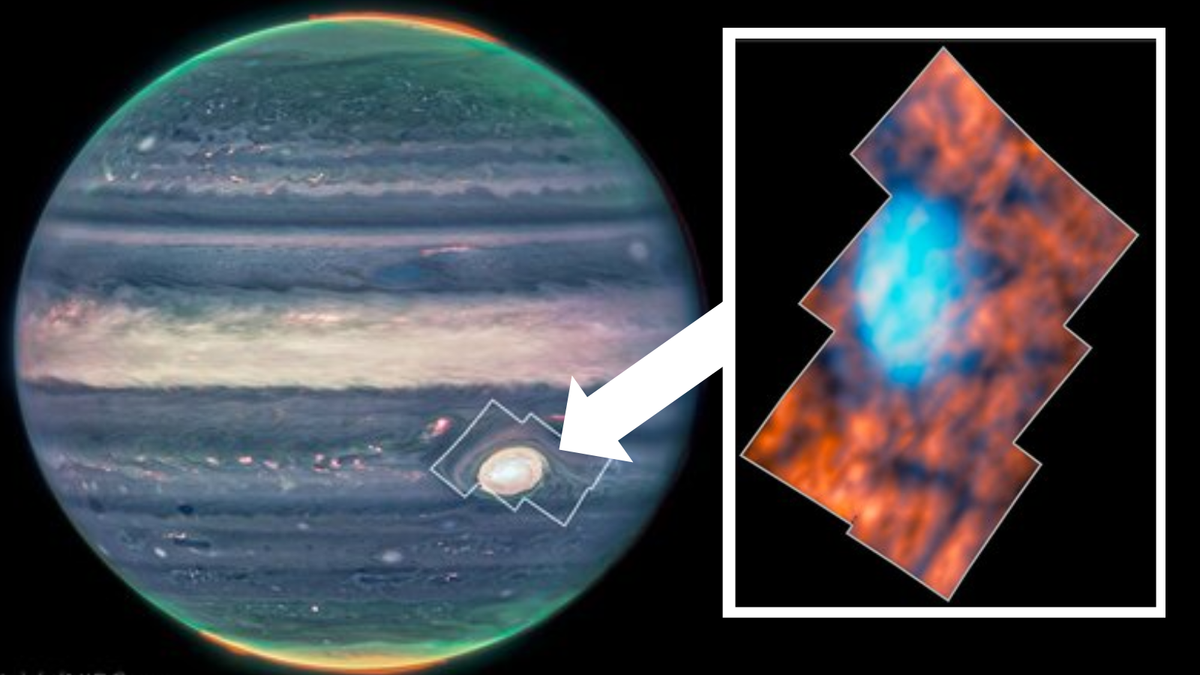
Astronomers have revealed a new scientific discovery related to Jupiter after the James Webb Space Telescope captured unprecedented images showing what researchers described as “cold fingerprints” inside the giant planet’s polar auroras.
Jupiter is known for producing the most powerful auroral displays in the Solar System, where glowing light phenomena appear around the planet’s poles as high-energy particles collide with its atmosphere.
However, the new observations indicate that Jupiter’s moons can influence this phenomenon in an unexpected way. Interactions between the moons and the planet’s enormous magnetic field appear to create unusual thermal regions within the auroras.
Jupiter’s Auroras Are Among the Strongest in the Solar System
Auroras on Jupiter are among the most active astronomical phenomena in the Solar System. They form when charged particles from space strike the planet’s atmosphere, releasing intense light energy around the polar regions.
The new study suggests that Jupiter’s atmosphere reacts very quickly to activity linked to the moons orbiting the planet, causing rapid changes in temperature and in the density of charged particles within the auroral zones.
Jupiter’s Moons Help Shape the “Auroral Fingerprints”
According to researchers from Northumbria University, analysis of data collected by the James Webb Space Telescope revealed that the four largest moons orbiting Jupiter strongly influence its magnetic environment.
These moons include:
Io
Europa
Ganymede
Callisto
These are known as the Galilean moons, among the largest bodies orbiting Jupiter. The study found that interactions between these moons and the planet’s magnetic field push charged particles toward Jupiter’s atmosphere, producing light patterns within the auroras that correspond directly to the moons’ positions in their orbits.
Io: A Massive Source of Charged Particles
The moon Io is one of the most geologically active bodies in the Solar System, featuring intense volcanic activity that releases huge amounts of charged particles into the space surrounding Jupiter.
These particles form what scientists call the “Io plasma torus,” a ring of ionized particles encircling the giant planet.
When the Galilean moons pass through this region and through Jupiter’s magnetic field, ions are directed toward the planet’s atmosphere, strengthening the auroral displays and creating light signatures linked to each moon.
Discovery of a “Cold Spot” Within the Auroras
While analyzing five images captured by the James Webb Space Telescope in September 2023, scientists observed an unexpected phenomenon beneath the auroral footprint associated with Io.
Researchers discovered a relatively cold region within the aurora, where temperatures dropped to about 509°F (265°C)—a noticeable decrease compared with surrounding areas.
At the same time, ion density in this region increased dramatically, reaching nearly 45 times higher than in nearby auroral regions.
Rapid Changes Within Minutes
The data also showed that temperatures and particle densities within Io’s auroral footprint can change within just minutes. This suggests the presence of high-energy, unstable electrons moving along Jupiter’s magnetic field lines.
These findings demonstrate that Jupiter’s atmosphere responds rapidly and intensely to surrounding space activity, particularly the interactions between the planet and its moons.
Comparison With Earth and Other Planets
Unlike Jupiter, Earth’s Moon does not directly influence auroras on our planet. However, scientists believe that some moons in the Solar System may affect the auroras of the planets they orbit.
For example, researchers suspect that the moon Enceladus of Saturn could have a similar effect on Saturn’s auroras.
Understanding these interactions helps scientists better grasp the complex ways giant planets and their moons influence one another, opening the door to deeper studies of magnetic environments across the Solar System.


